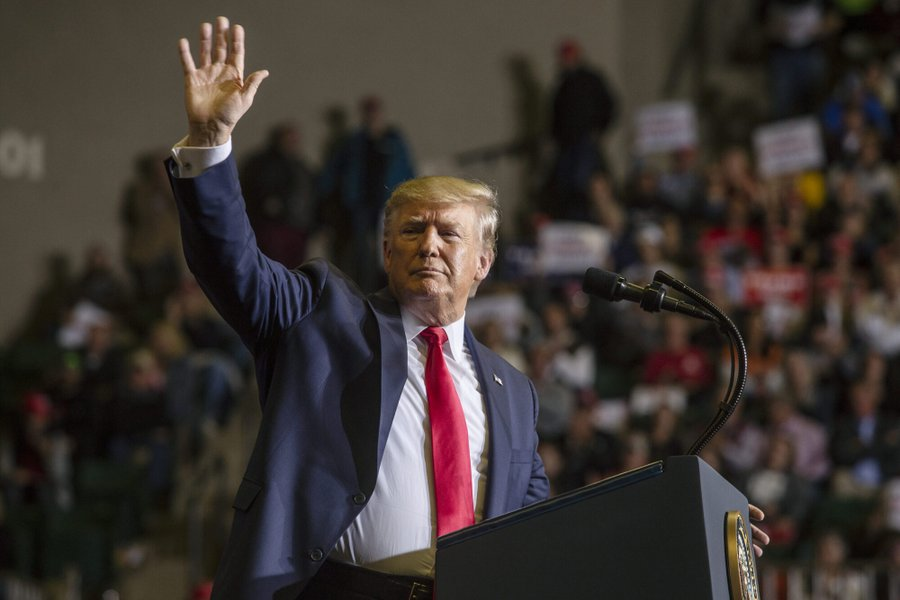
On the contrary, the real American crisis is not merely political—it is moral. We are confronted with a President whose character appears fractured, whose words and actions often stand in contradiction.
It is not enough to say, as Republican strategist Stuart Stevens suggests, that “an entire political movement chose him.” That may be true, but it does not absolve the deeper concern. Democracy may explain how power is acquired, but it does not justify how it is exercised.
If a leader is perceived as hypocritical and duplicitous—saying one thing while doing another—then trust becomes an impossible currency. And without trust, diplomacy falters.
How can adversaries, such as Iran, take seriously the promises of a man whose actions disrupt his own negotiations? To speak of peace while advancing conflict is to erode credibility on the world stage. No one bargains confidently with inconsistency.
In one moment, Trump claims to be negotiating with Iran to end the war, while in the next he contemplates putting boots on the ground. Reports indicate that just before military action against Iran, diplomatic channels had been engaged regarding its nuclear program—yet, without warning, strikes followed. Even now, the language of negotiation persists alongside the shadow of force.
Is it wishful thinking to believe that Iran—or anyone—can trust the United States under such conditions?
Even traditional allies in NATO and the European Union have shown signs of unease—questioning commitments and recalibrating expectations—after treaty disruptions, territorial rhetoric, and sweeping tariff threats. When consistency falters, confidence follows.
Indeed, this is the deeper problem.
And yet, perhaps this is not new.
History reminds us that humanity has long wrestled with its own contradictions. In the biblical account, the crowd chose Barabbas—a criminal—over Jesus. They freed one they feared and condemned one they did not understand. It was not simply a political decision; it was a reflection of human frailty.
Two thousand years later, the pattern feels hauntingly familiar.
We are still choosing. Still weighing spectacle over substance, impulse over integrity.
Perhaps nothing has changed—or perhaps the burden has always been ours to bear.
For nations do not collapse in a single moment of chaos; they erode in the quiet compromises we justify, the contradictions we excuse, and the character we overlook.
And if we continue to choose power over principle, spectacle over substance, then the crisis is not the President.
The crisis is us.
By Rev. Renaldo McKenzie, Author of Neoliberalism, Globalization, Income Inequality, Poverty and Resistance
Reference:
Start Stevens, Political consultant Stuart Stevens recalls when Republicans made character an issue for the president, in Mississippi Today, published March 27th, 2026, https://mississippitoday.org/2026/03/27/character-president-stuart-stevens-republican/?fbclid=IwVERTSAQ0DRZleHRuA2FlbQIxMABzcnRjBmFwcF9pZAwzNTA2ODU1MzE3MjgAAR5dxWL2Tn-K36XrrmMRGFjBwMt33Bl-td7Y-oTMtDt6EnVfh0LuxXLYdoEQXg_aem_5DIwXfpv8oP9BAXT8eqlnQ Visit
Available on YouTube:
Donate to us at Via Stripe: https://donate.stripe.com/7sYcN48uybAA2OEb9V93y06