
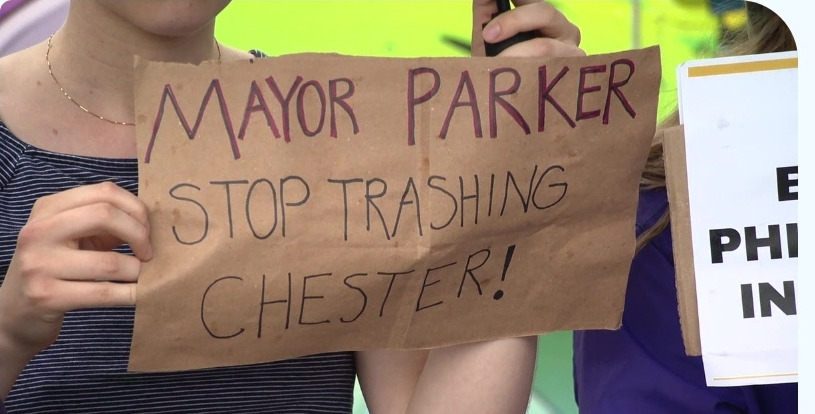
The fight between Chester residents and the City of Philadelphia is no longer a quiet local dispute buried beneath bureaucracy and smoke stacks. It is becoming a regional confrontation over race, power, pollution, environmental justice, and political accountability.
On Thursday, residents from Chester traveled into West Philadelphia to protest outside Mayor Cherelle Parker’s budget meeting, demanding that Philadelphia stop sending its trash to Chester to be burned at the Reworld/Covanta incinerator — one of the largest trash incinerators in the United States.
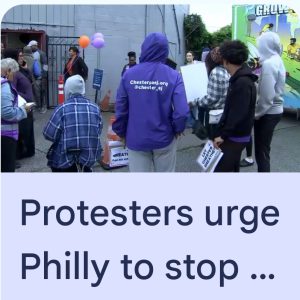
Among the protesters was Dr. Nolan Fontaine, youth coordinator for Chester Residents Concerned for Quality Living (CRCQL), who joined me on The Neoliberal Round Podcast to discuss the growing movement.
“It absolutely is an injustice,” Fontaine said during the interview.
According to Fontaine, Philadelphia sends approximately 35% to 40% of its trash to Chester, where it is burned daily at the waterfront incinerator located only blocks from residential neighborhoods. The facility reportedly burns roughly 3,500 tons of waste every day.
The irony, critics argue, is painful and obvious.
Philadelphia promotes itself as pursuing a “cleaner, greener Philadelphia,” while simultaneously exporting massive quantities of waste into a majority-Black city already burdened by poverty, illness, industrial decline, and environmental hazards.
“Philadelphia got rid of incinerators,” Fontaine noted, “but they’re dumping their trash on their neighbors.”
Residents argue that the consequences are visible not merely in statistics, but in the bodies of the people living there: asthma, COPD, respiratory illnesses, cancer concerns, foul odors, and degraded living conditions.
Fontaine described the smell hanging over parts of Chester as resembling “trash can juice at the bottom of the trash can.” It is the kind of description that does not leave the mind easily. It lingers. Like smoke.
The movement opposing the incinerator has deep roots. CRCQL has been engaged in environmental justice struggles for decades and, according to Fontaine, previously fought against hazardous waste facilities and other environmentally dangerous developments proposed for Chester.
The current fight centers partly around proposed legislation in Philadelphia known as the Stop Trashing Our Air Act, introduced by Councilmember Jamie Gauthier. The legislation would restrict the city from entering waste disposal contracts with incineration companies.
But activists say political resistance remains strong.
During the interview, Fontaine alleged that Mayor Parker has refused to sit down with organizers while campaign finance records show financial ties between her campaign and the incinerator company. The interview referenced reporting by WHYY indicating that Reworld, formerly Covanta, spent tens of thousands lobbying Philadelphia officials and also contributed to Parker’s campaign.
These allegations intensify concerns many residents already have: that poor and Black communities are routinely sacrificed in the name of economics and political convenience.
Environmental racism is not merely about pollution. It is about geography and power. It asks who breathes clean air and who does not. Who receives investment and who receives waste. Who is protected and who is considered expendable.
For many in Chester, this fight represents more than garbage contracts. It represents decades of abandonment.
The situation is further complicated by long-standing “host agreements” between Chester and the waste companies. Fontaine explained that these agreements, some dating back to the early 1990s, limit the city’s ability to stop the operations outright.
Still, resistance continues.
CRCQL’s youth arm, known as CHOICES, has mobilized young people across generations to speak at hearings, organize demonstrations, and educate the public.
That may be the most important part of this story.
Young people in Chester are learning early that democracy is not merely voting every few years. Sometimes democracy is standing outside power structures holding signs while police officers watch. Sometimes democracy is demanding that your community not become the dumping ground for another city’s comfort.
And perhaps the deepest tragedy is this: many Philadelphians reportedly had no idea where their trash was going.
The smoke drifting above Chester has long remained invisible to those benefiting from the arrangement.
Now, residents are making sure it can no longer be ignored.
By Rev. Renaldo McKenzie, Prof.
For The Neoliberal Corporation
