
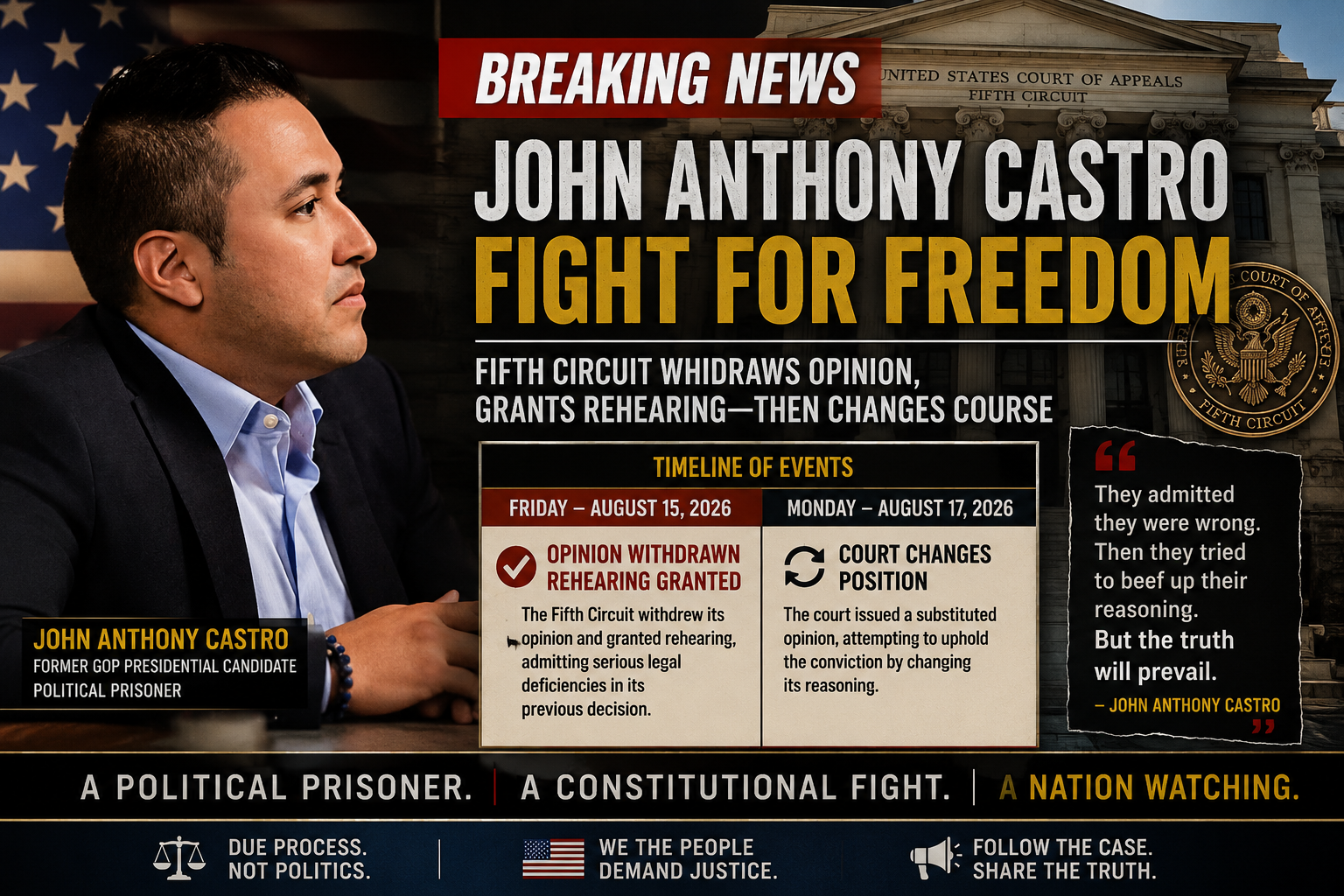
There has been a significant new development in John Anthony Castro’s fight for freedom.
On Friday, the U.S. On Friday, the U.S. Court of Appeals for the Fifth Circuit withdrew its previous opinion. It granted rehearing in John Castro’s federal case. Castro argues the move validates serious legal deficiencies he identified in the appellate court’s original reasoning.
But by Monday, August 17, 2026, the situation had shifted again.
Rather than granting John Castro the relief he believes should follow from problems with the original opinion, the panel issued a revised opinion that attempts to preserve the result while changing portions of its reasoning.
In our latest conversation with John Castro, the former Republican presidential candidate described the extraordinary sequence of events and explained why he believes the substituted opinion creates new legal problems rather than resolving the old ones.
From Withdrawal to a Substituted Opinion
The central dispute concerns a sentencing enhancement imposed on Castro for allegedly exercising a leadership role in criminal activity.
According to Castro, the Fifth Circuit’s original opinion reasoned that the leadership enhancement could stand without a finding that another person was criminally responsible.
John Castro attacked that reasoning in his petition for rehearing.
His argument was strikingly simple: How can someone legally be considered the leader of criminal activity if the government and the district court never established that another criminally responsible participant whom he led existed?
As Castro summarized the problem during our interview, the original reasoning effectively made him:
“a leader of no one.”
Then came Friday’s dramatic development.
The panel withdrew its opinion and granted rehearing.
For Castro, the withdrawal was an important acknowledgment that something was seriously wrong with the original decision. It is important, however, to distinguish withdrawing or replacing an opinion from a judicial admission that the court was legally “wrong” on every disputed issue. The precise meaning of Friday’s order must ultimately be determined from the language of the court’s order itself.
What happened next is where the controversy deepened.
By Monday, the Court Had Changed Its Reasoning
By Monday, August 17, the Fifth Circuit had issued a substituted opinion.
Castro argues that instead of correcting the underlying problem, the panel attempted to strengthen—or, in his words, “beef up”—its reasoning by adding a new rationale.
According to Castro’s description of the substituted opinion, the panel now reasons that, based upon the record as a whole, it was plausible that at least one other person was involved or criminally responsible.
But Castro says that creates an entirely different constitutional and appellate problem:
Where did that factual finding come from?
Castro argues that the district court never expressly made the finding upon which the appellate panel now relies.
And that distinction could be crucial.
An appellate court ordinarily reviews factual findings made in the district court. Castro contends that the Fifth Circuit cannot rescue a deficient sentencing determination by supplying a factual finding that the trial judge himself never made.
He calls what happened “appellate fact-finding.”
In other words, according to Castro, the Fifth Circuit repaired one hole in its opinion by opening another.
“They Withdrew It—Then Tried to Beef It Up”
Castro believes Friday’s withdrawal demonstrated the strength of his challenge.
He says the Fifth Circuit had approximately 20 months to consider the appeal, yet after he filed a petition for rehearing, the panel withdrew the appeal.
But Castro argues that Monday’s substituted opinion did not resolve the fundamental issues.
Instead, he says the panel changed its rationale while still reaching essentially the same result.
His accusation is serious: that the appellate court is working backward from a predetermined outcome—affirming his conviction and sentence—and searching for legal reasoning to sustain it.
That remains Castro’s allegation, not an established finding concerning the motives of the Fifth Circuit judges.
Nevertheless, the withdrawal and substitution of the opinion make the evolving appellate record itself worthy of close examination.
The Linda Rivera Evidence: Impeachment or Evidence of Motive and Bias?
Castro also continues to challenge the Fifth Circuit’s treatment of evidence involving government witness Linda Rivera.
According to Castro, information concerning Rivera’s potential exposure to criminal prosecution and alleged favorable treatment or immunity should not have been treated merely as general impeachment evidence.
He argues that it was evidence of something much more important:
motive and bias.
The distinction matters because evidence suggesting that a government witness had something to gain from cooperating with prosecutors may bear directly upon the witness’s incentive to testify.
Castro argues that the Fifth Circuit improperly blurred ordinary impeachment evidence together with evidence demonstrating motive or bias and that this treatment conflicts with Supreme Court precedent governing disclosure of evidence favorable to a criminal defendant.
He maintains that the issue implicates the government’s constitutional disclosure obligations under Brady v. Maryland and related cases.
Whether Castro can establish a constitutional violation—and whether any disputed evidence was suppressed and sufficiently material to require relief—remains for the courts to determine.
Why Were Castro’s Trump Lawsuits Part of the Case?
There is another question that remains difficult to ignore.
What does Donald Trump have to do with John Anthony Castro’s federal tax prosecution?
Before his incarceration, Castro was a Republican presidential candidate who brought litigation seeking to prevent Donald Trump from appearing on presidential ballots under Section 3 of the Fourteenth Amendment.
Castro argues that his lawsuits involving Trump and IRS personnel were improperly characterized as evidence of obstruction.
He counters that filing lawsuits and petitioning courts are exercises of constitutional rights and that lawful litigation cannot simply be transformed into criminal obstruction because the government dislikes the litigation.
The Fifth Circuit’s treatment of that issue is therefore another component of Castro’s continuing challenge.
And it raises a broader constitutional question: Where is the boundary between genuine obstruction and the protected exercise of a citizen’s right to petition the courts?
Castro Files Another Challenge
Castro is not accepting Monday’s substituted opinion as the final word.
He told The Neoliberal Round Podcast that he has already responded with extensive filings seeking further review.
According to Castro, those filings exceed 120 pages and include requests for panel rehearing, en banc rehearing, and publication of the decision.
Rehearing en banc would potentially place the case before a larger complement of Fifth Circuit judges rather than leaving the disputed issues solely with the original panel.
Castro is also preparing for the possibility that the battle will eventually move beyond the Fifth Circuit.
If necessary, he says he intends to petition the United States Supreme Court for a writ of certiorari.
Friday Changed the Story
Friday’s withdrawal matters.
But we should describe precisely what it establishes.
A withdrawn appellate opinion is not, standing alone, proof of corruption, political retaliation, prosecutorial misconduct, or Castro’s innocence. Nor does granting rehearing necessarily mean that an appellate court has conceded every argument made by a defendant.
But neither should the development be casually dismissed.
When an appellate panel withdraws an opinion following a petition challenging its reasoning and then issues a substituted opinion addressing disputed points differently, the change itself becomes part of the story.
The question now is whether the substituted opinion actually cures the legal deficiencies Castro identified—or merely reaches the same destination by another road.
Castro believes it is the latter.
And he intends to keep fighting.
The Fight for Freedom Continues
During our conversation, Castro remained remarkably determined.
He believes his faith will sustain him through incarceration and through what could become a lengthy appellate struggle.
He believes the truth will ultimately emerge.
And he has authorized The Neoliberal Round Podcast to continue sharing his conversations and documenting his fight.
We will do precisely that.
But our responsibility is larger than advocating for one individual.
It is to ask difficult questions of powerful institutions.
America was not founded upon the proposition that government officials are beyond scrutiny. Its constitutional experiment rests upon precisely the opposite idea: power must remain accountable to law.
Judges must follow the law.
Prosecutors must follow the Constitution.
Defendants must receive due process.
And journalists and citizens must remain free to question all of them.
John Anthony Castro may ultimately prevail on some of his claims and lose on others. That determination belongs to the courts and must be based upon the actual record, controlling precedent, and constitutional law.
But when an incarcerated man challenges the machinery of the federal government, and an appellate court withdraws an opinion only to return days later with altered reasoning, there is a legitimate public-interest story to follow.
We are following it.
The fight did not end Friday.
It did not end Monday.
And John Anthony Castro says he is prepared to take it all the way to the Supreme Court.
The fight for freedom continues.
Editor’s Note: This report incorporates statements made by John Anthony Castro during an interview with Renaldo McKenzie for The Neoliberal. Allegations concerning prosecutorial misconduct, witness agreements, transcript alterations, political retaliation, judicial motives, and improper appellate fact-finding are Castro’s allegations and legal arguments unless independently established by court records or judicial findings.
Written by: Renaldo McKenzie, Content Chief, The Neoliberal
Renaldo McKenzie is the author of Neoliberalism, Globalization, Income Inequality, Poverty and Resistance.
Email us at [email protected]. Call us at 445-260-9198.
Donate to us: https://donate.stripe.com/7sYcN48uybAA2OEb9V93y06
Related Articles:
John Anthony Castro Continues Fight for Freedom, Appeals to Supreme Court and International Bodies
John Anthony Castro Says Fifth Circuit Appeal Remains Active, Expects Decision by Summer
FOR IMMEDIATE RELEASE Update on John Anthony Castro’s Constitutional Claims and Pending Motions
Why the Castro V Trump Lawsuit Matters in the US 2024 Presidential Elections