My first son surprised himself… how impressed he was with his father (me), when he noticed I had a Critical Theory reading list on my bookshelf (back when I lived at the church): Horkheimer, Marcuse, Habermas. It was one of those, “Wait, my parent actually knows about something I think is important “ epiphanies.
Ben was leading a Marxist reading group in West Philly, and I can knowledgeably discuss Adorno, Althusser and Gramsci. I can even fake my way through Foucault, if I have to. (All it really means is I studied with Cornell West at Union, and I began a Ph.D. at Columbia in the mid-80’s – when the first year of doctoral studies in many fields was way too much Foucault and the shifting meaning of texts!)
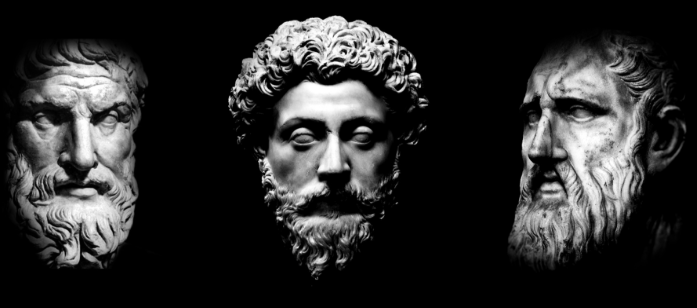
We had another moment like that recently when he was telling me about the Stoic group he runs at NYC’s Ethical Culture Society. I responded, “I always like Epictetus more than Marcus Aurelius.” There was silence on the other end of the phone. Then, “You’ve read the Stoics?” Me: “In a Greek Philosophy seminar my senior year in college, and in high school, Marcus Aurelius’ Epistulae in Latin, but his Meditations were written in Greek.” The last tidbit stopped him in his tracks. Now he even calls me for advice…
Maybe that’s why I noticed this motherload of Stoic advice recently. Stoicism has become quite popular again – even Toni is reading it! I’ve taken some wisdom from what the The Daily Stoic offered in the early days of the pandemic “when the whole world was freaking out.” Some of it is even more pointed and helpful when now the whole world is falling apart! I am not a Stoic, but I can still learn from them or take some of their advice!

ACCEPT WHAT’S OUTSIDE OF YOUR CONTROL; GET TO WORK ON WHAT IS NOT: The worst part of our current situation is for many the helplessness. In the face of so much we can’t control… so many things that won’t change no matter how hard we wish or try, it’s easy to forget what you can do, especially when it doesn’t feel like much. The Family Therapist Rabbi Edwin Friedman pointed out, ‘You can’t fix others or complex situations; you can only work on yourself.’ In the Art of Living, Epictetus wrote, “Within our own control are our own opinions, aspirations, desires and the things that repel us. These areas are quite rightly our concern, because they are directly subject to our influence.”
HAVE CONFIDENCE IN YOUR ABILITY TO MAKE THE BEST OUT OF ANYTHING: In modern terms, this might be summed up as 1) resilience. And that’s a wonderful skill to find you have and / or to work on acquiring / strengthening. But for the Stoics, more than resilience, it’s character, virtue, growth. So 2) since we’re in Advent, we might borrow from the Baptist and speak about “purifying and refining with fire.” Or a bit of Nietzsche – “from life’s school of war, what doesn’t kill me makes me stronger.” Or Hemingway’s “The world breaks everyone, and afterwards many are strong at the broken places.” Or the Apostle Paul: “…we know that suffering produces perseverance; perseverance, character; and character, hope” (Romans 5:3-4). Like it or not, there are tough times we have to endure. Sometimes I find perspective remembering that others have suffered much more (Bill Coffin used to say, “Worse things have happened to better people!”). And isn’t there some comfort (the silver lining) in believing that we will emerge from our trials somehow improved. Remember Epictetus’s words, “The true man is revealed in difficult times. So when trouble comes, think of yourself as a wrestler whom God, like a trainer, has paired with a tough young buck. For what purpose? To turn you into Olympic class material.”
EXAMINE THE COST OF PANIC AND EMOTIONAL REACTIONS: My friend and colleague Geoffrey once told us in a staff meeting: “Somewhere along the way, I realized that anxiety and anger don’t make anything easier, so I avoid them.” We laughed that most humans don’t have quite so much choice or self-control. Emotional reactions tend to be first, fast and often initially furious. But because they are “automatic” does mean we need to let ourselves go with them. The stoics counsel is to rely on our better judgment to mediate our emotional impulses and protect ourselves and others from the consequences of strongest and “uncontrollable” emotional reactions. Seneca said, “The best remedy for anger is delay.”
BUILD A ROUTINE TO COUNT ON: When times are at their most chaotic, it’s important to create whatever order — or some semblance of order — for ourselves we can. A routine gives us a structure and a sense of security. No matter what else happens, you know you can take your walk in the morning or pray before bed. Routines have a calming effect. Stoics prescribe that your routine has some activity with which you can help focus and reflect (for me, curiously, that’s the gym?). A routine is something you can control in a largely uncontrollable world. It can provide a buffer against being overwhelmed by daily obstacles, so you don’t have to meet the chaos with a matching frenzy of fear or anxiety. Instead, you help create for yourself a better place: that place of calm and stillness. Marcus Aurelius asked, “Do the things external which fall upon you distract you? Give yourself time to learn something new and good, and cease to be whirled around.”
TAKE CARE OF YOUR RELATIONSHIPS: Stoicism is a philosophy stressing independence and strength, moral rectitude and inner-life. But it’s not a prescription for isolation (or a sentence to loneliness). Not islands, we are social animals. We need community, more so in tough times. We are made better for caring and being cared for. That’s what the idea of sympatheia is really about — the feeling of knowing you belong to a larger whole. Stoics mean to be strong / better for their contribution to humanity. Seneca wrote: “We are the parts of one great body. Nature produced us related to one another, since she created us from the same source and to the same end. She engendered in us mutual affection, and made us prone to friendships.”
FOCUS ON THE SMALLEST THING YOU CAN DO RIGHT NOW: James Clear, author and consultant on habit formation challenges us to become just one percent better every day. “The difference a tiny improvement can make over time is astounding. Here’s how the math works out: if you can get 1 percent better each day for one year, you’ll end up thirty-seven times better. (I don’t understand the math, but you get the point!) Zeno puts it even pithier: “Well-being is realized in small steps, but it’s no small thing.”
Written by: Michael Caine, Rev.